
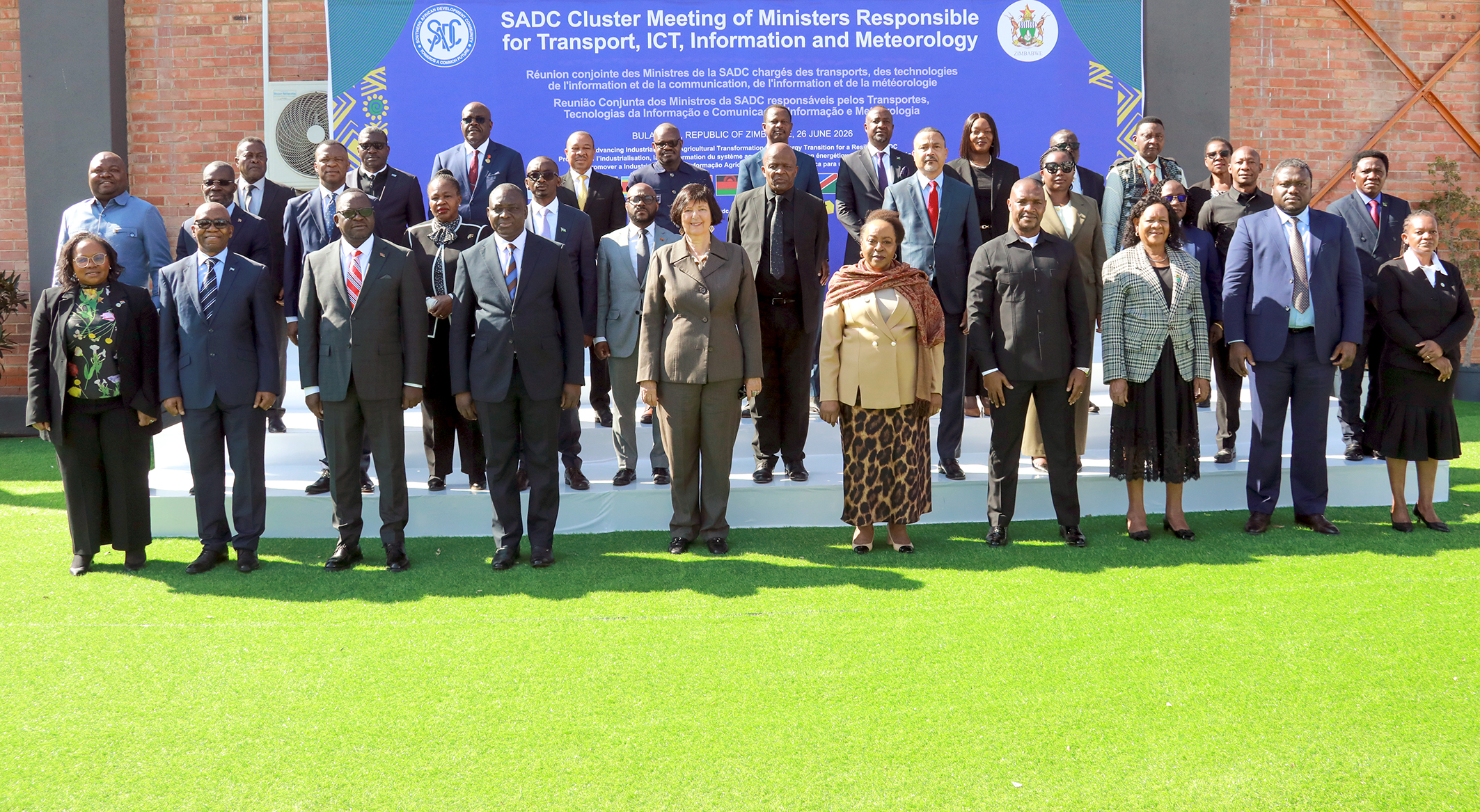
The Southern African Development Community (SADC) Cluster Meeting of Ministers responsible for Transport, Information and Communication Technologies (ICT), Information, and Meteorology was held in Bulawayo, Republic of Zimbabwe, on 26 June 2026.
The Ministers called for accelerated regional integration through the modernisation of transport systems, strengthened safety and governance frameworks, improved cross-border connectivity and resilient early warning systems. These efforts are to be supported by coordinated investments in aviation, road, rail, maritime and digital infrastructure, with a strong emphasis on sustainable, resilient, and green transport solutions driven by collaboration, partnerships, innovation to enhance trade, economic growth and global competitiveness.
The meeting was hosted by the Government of Zimbabwe and chaired by the Honourable Ms. Barbara Creecy, Minister of Transport of the Republic of South Africa, in her capacity as Chairperson of the SADC Committee of Ministers responsible for Transport, ICT, Information and Meteorology.
Minister Creecy underscored the importance of strengthening regional cooperation to modernise infrastructure, enhance connectivity and leverage emerging technologies to advance regional integration and economic transformation. She stressed that investment in resilient infrastructure and digital innovation is critical to improving trade, facilitating the movement of people and goods and strengthening the region’s competitiveness. She further highlighted that digital transformation, reliable information systems, meteorological services and regional cooperation are essential enablers of safe, efficient, climate-resilient and integrated transport systems.
She noted progress under the SADC Trade and Transport Facilitation Project, particularly in customs interconnectivity, transit management systems, corridor development, railway planning, port modernisation, all of which are contributing to improved regional trade and integration. She also called for accelerated implementation of air transport reforms under the Single African Air Transport Market (SAATM) to enhance aviation safety and governance, alongside increased investment in multimodal infrastructure and strengthened institutional capacity.
Honourable Dr. Zhemu Soda, Minister of Information, Publicity and Broadcasting Services of the Republic of Zimbabwe, emphasised the interconnected nature of the transport, ICT, information, and meteorology sectors as key drivers of regional integration, resilience and economic transformation. He called for stronger coordination, increased investment, harmonised systems, digital transformation and regional solidarity to address shared challenges and fully unlock the potential of these sectors.
He further highlighted key national and regional developments, including the establishment of regional broadcasting platforms to strengthen governance and integration, continued investment in early warning systems to improve weather forecasting and disaster preparedness, road infrastructure rehabilitation, and the development of digital platforms aimed at building a more integrated, secure and resilient Southern Africa.
Mrs. Angele Makombo N’tumba, SADC Deputy Executive Secretary responsible for Regional Integration, highlighted steady progress in implementing key regional frameworks, including the Regional Indicative Strategic Development Plan (RISDP) 2020-2030, the Short-Term Action Plan (STAP II) of the Regional Infrastructure Development Plan (RIDMP) 2012–2027, the SADC Digital Transformation Strategy, the SADC Postal Strategy, and Corridor Development Plans, all aligned with the SADC Vision 2050.
She emphasised that SADC is not only modernising existing systems but is also planning for future infrastructure needs, while strengthening digital and climate resilience and deepening regional cooperation and partnerships to achieve long-term development objectives.
During the meeting, Ministers deliberated on strategic priorities to accelerate regional integration through improved infrastructure and policy coordination. Key focus areas included strengthening regional transport corridors, advancing digital transformation and ICT integration, enhancing climate resilience through improved meteorological services and promoting innovation, including the responsible adoption of Artificial Intelligence (AI) to improve infrastructure planning, service delivery and operational efficiency.
Ministers also reviewed progress in implementing regional programmes aimed at improving transport systems, expanding digital connectivity, strengthening information services, and enhancing weather and climate information systems to support disaster risk reduction and sustainable development.
The ICT and Information agenda focuses on building a secure, connected and digitally integrated SADC region through enhanced cybersecurity systems, expanded broadband and satellite infrastructure, advanced digital transformation strategies, improved emergency communication systems and the development of regional media platforms that support integration, trade and a shared regional identity. The outcomes of the meeting are expected to contribute to more efficient transport and communication systems, improved trade facilitation, enhanced digital connectivity, strengthened climate resilience and inclusive economic growth across the region.
The Cluster Meeting reaffirmed SADC’s commitment to deepening regional integration through coordinated infrastructure development, policy harmonisation, and strengthened cooperation among Member States. The meeting brought together Ministers from SADC Member States, senior government officials and representatives of international and regional cooperating partners.
The Cluster Meeting was preceded by the SADC High-Level Ministerial Roundtable Dialogue on Liberalised Skies and AI-Enabled Climate-Resilient Infrastructure held on 25 June 2026, as well as the SADC Cluster Meeting of Senior Officials responsible for Transport, ICT, Information, and Meteorology held from 22–24 June 2026. These engagements also informed the strategic priorities for advancing regional integration, connectivity and sustainable development across the SADC region.


